
Next-day callout slots available for Wigan & surrounding areas
Postcode
WN2
Council
Wigan Council
Nearest road
A58 Atherton Road
From Wigan
3 miles east

Why locals choose Brogas here

Brogas is a Gas Safe registered business. We accurately diagnose the cause of high boiler pressure, clearly explain the required repairs, and provide you with a transparent understanding of the parts and labour involved to restore your heating system to proper working order.

Typical boiler pressure too high — parts, labour and what drives the cost work in Hindley

For Hindley householders and landlords dealing with parts, labour and what drives the cost. Local housing stock — 2-up-2-down Victorian terraces and post-war semis toward Hindley Green — shapes how this work is carried out.

  • Understanding why your repair cost differs from a neighbour's.
  • Deciding between repairing a single component or a larger part.
  • Knowing what to ask your engineer during the diagnostic phase.
  • Preparing for potential parts and labour costs.
  • Gaining insight into common high-pressure faults and fixes.

Parts Commonly Replaced for High Boiler Pressure

Addressing high boiler pressure typically involves replacing one or more key components. The most frequent culprit is a failed expansion vessel, which can no longer absorb system pressure fluctuations. We also frequently find a pressure relief valve (PRV) that's started to pass, or a plate heat exchanger allowing mains water into the sealed system. Less commonly, but still a factor, is a filling loop that's been left slightly open or has developed an internal leak. Each of these parts has a different material cost and associated labour time for replacement.

  • Expansion vessel (internal or external)
  • Pressure Relief Valve (PRV)
  • Plate heat exchanger
  • Filling loop

Labour and Diagnostic Time – What Drives the Cost

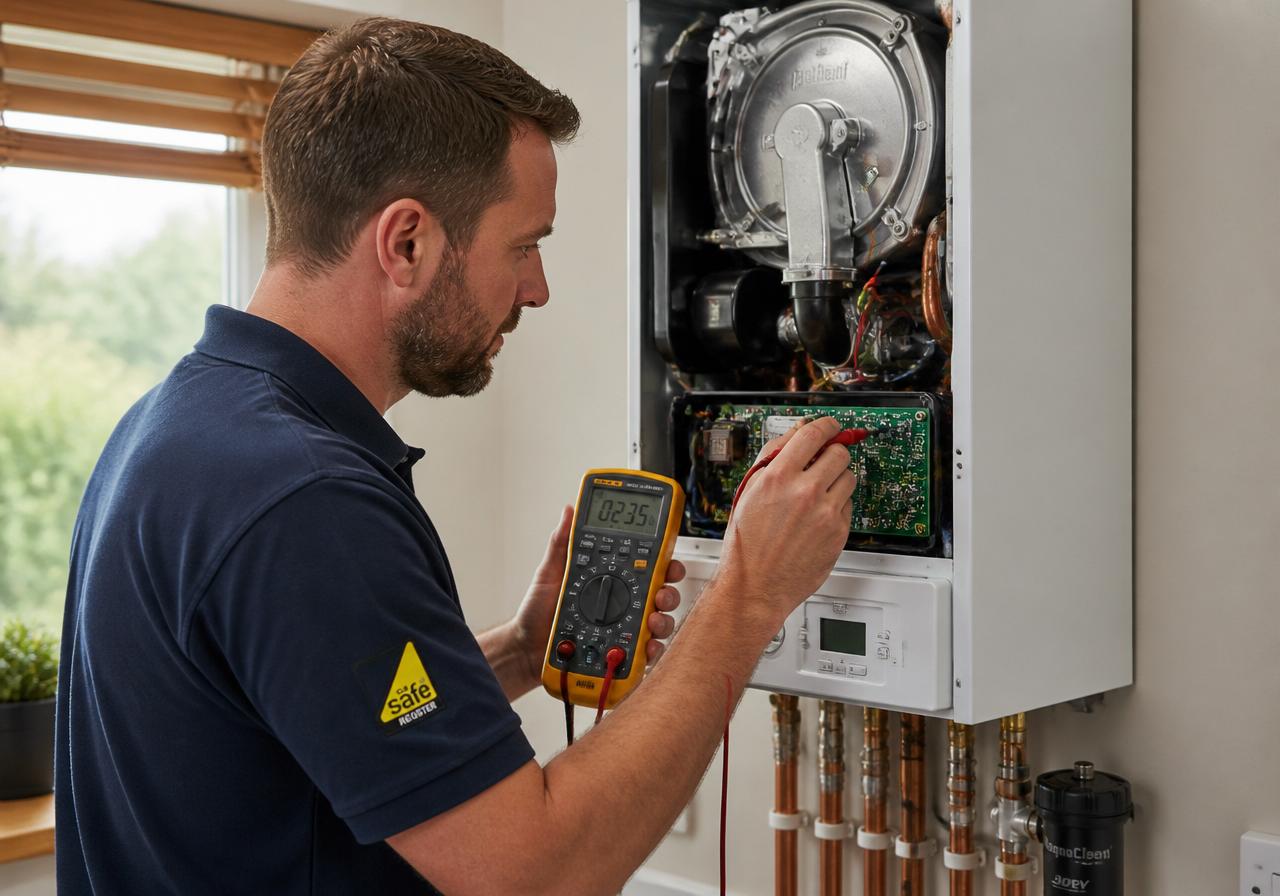
The 'labour' aspect covers both the diagnostic time and the actual replacement work. We start by systematically checking the filling loop, then testing the expansion vessel's charge when the system is cold. We also visually inspect the PRV for signs of water discharge or wear. If these don't pinpoint the issue, we move to testing the plate heat exchanger. Complex diagnostic work or difficult-to-access components, particularly in older Hindley properties where boilers might be less accessible, can increase the total time on site, impacting the overall cost.

  • Testing expansion vessel charge (cold)
  • Inspecting the Pressure Relief Valve
  • Checking the filling loop operation
  • Diagnosing a passing plate heat exchanger

Identifying Specific Faults and Your Options

Our diagnostic process is designed to accurately identify the specific fault causing your high pressure. For example, a failed expansion vessel is often a straightforward replacement. A passing plate heat exchanger requires a more involved repair, as it means dismantling parts of the boiler. We provide clear explanations of the issue and the necessary repair, allowing you to understand what's happening inside your system. Manufacturer warranty depends on model and registration — check your documentation for specific cover details.

  • Accurate fault identification is key
  • Clear explanation of repair requirements
  • Understanding different repair complexities
  • Manufacturer warranty depends on boiler specifics

Hindley FAQs — boiler pressure too high — parts, labour and what drives the cost

Why does my boiler pressure keep rising after topping up?+

This often points to a failed expansion vessel. It's designed to absorb excess pressure as the water heats up. If it's not working, the pressure will continually climb. Alternatively, a filling loop left open or passing can also cause this.

What is a 'passing' Pressure Relief Valve (PRV)?+

A passing PRV means the valve's internal seat is no longer sealing correctly, allowing water to escape even when the system pressure isn't excessively high. This often manifests as a drip from the small copper pipe outside your property.

How do you test an expansion vessel?+

We check the pressure within the expansion vessel when the system is cold and depressurised. If the pressure is too low or non-existent, it indicates the vessel has failed and requires either re-pressurising or replacement if the diaphragm is ruptured.

Can a faulty plate heat exchanger cause high pressure?+

Yes. A failed plate heat exchanger can allow mains water, which is at a higher pressure, to enter the sealed central heating system. This directly increases the system pressure and is a specific fault we can identify and confirm.

In summary

High boiler pressure requires specific fault diagnosis. Understanding the parts, labour, and typical costs helps in making informed repair decisions for your heating system.

Get a Hindley quote

Free · No obligation

Get Your Free Quote

We'll respond the same working day.

We reply to every enquiry within one working day.