
Next-day callout slots available for Wigan & surrounding areas

Boiler Losing Pressure — The diagnostic sequence in Standish

Boiler Losing Pressure in Standish: Our Diagnostic Sequence

You're likely here because your boiler pressure gauge keeps dropping. Perhaps it needs topping up every few days, or maybe it's happening more frequently. While the natural inclination might be to keep adding water, a persistent pressure drop is a clear sign something isn't right. Pressure doesn't just vanish; it either escapes through a leak, exits via a faulty pressure relief valve, or the gauge itself is providing a misleading reading due to an internal component issue. As Gas Safe engineers, our approach is methodical, designed to identify the root cause efficiently and accurately.

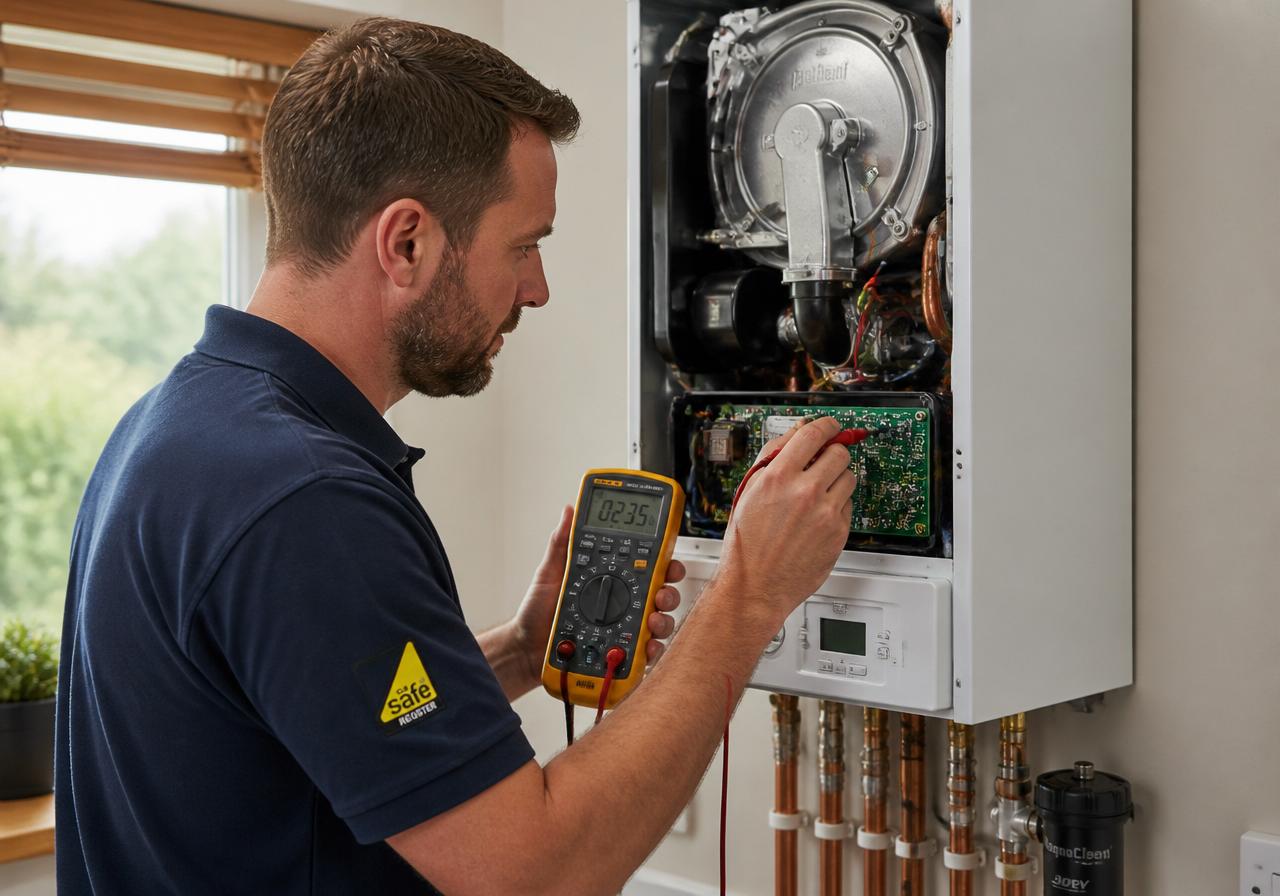
Engineer checking a boiler's pressure gauge and expansion vessel for diagnostic sequence.

Typical boiler losing pressure — the diagnostic sequence work in Standish

For Standish householders and landlords dealing with the diagnostic sequence. Local housing stock — 1930s bay-fronted semis on Rectory Lane and newer estates off Almond Brook Road — shapes how this work is carried out.

  • Boiler pressure drops after topping up.
  • You hear a faint dripping sound from outside.
  • Radiators seem to need bleeding often.
  • Your boiler's internal components look wet.
  • Pressure gauge fluctuates widely during operation.

The Common Case: Expansion Vessel Checks First

When a boiler starts losing pressure, the first component we investigate is almost always the expansion vessel. This is, by a significant margin, the most common culprit. A failed or under-charged expansion vessel will cause the system pressure to fluctuate wildly, often dropping significantly as the water cools. Our diagnostic process begins with pressure-testing the vessel and, if necessary, recharging it to the correct pressure or advising on its replacement. This initial step often resolves the issue for properties across Standish, saving time and avoiding unnecessary further investigation.

  • Test expansion vessel charge.
  • Recharge vessel if under-pressured.
  • Advise on vessel replacement if failed.

The Awkward Case: Pressure Relief Valve & Minor Leaks

If the expansion vessel checks out, our attention then shifts to the pressure relief valve (PRV). A weeping PRV can slowly discharge water from the system, often unnoticed, particularly if it's plumbed directly to an outside drain. We inspect the discharge pipe for any signs of water egress. Following this, we methodically check accessible system components for subtle leaks: radiator valve glands, towel rail joints, and other visible pipework connections. These 'weeping' leaks can be surprisingly hard to spot but contribute significantly to pressure loss.

  • Inspect PRV discharge for water.
  • Check all accessible radiator valves.
  • Examine towel rail connections for drips.

The Case That Needs a Different Answer: Buried Leaks and Boiler Faults

Only after ruling out the expansion vessel and visible minor leaks do we begin to consider more complex scenarios. This includes the possibility of a buried pipework leak, which can be particularly challenging in older properties around Standish. We employ specialist pressure-testing equipment to isolate sections of the system and pinpoint where the leak might be occurring, though locating these can be destructive. Finally, we would inspect the boiler's auto air vent, as a faulty one can also contribute to pressure loss directly from the unit itself. Guessing at these faults without following the sequence wastes money and time.

  • Pressure-test pipework sections.
  • Investigate for buried leaks.
  • Check boiler's auto air vent.

Local facts — Standish

Postcode
WN6
Council
Wigan Council
Nearest road
A49 / M6 J27
From Wigan
3.5 miles north

Standish is an affluent commuter village with quick M6 access, with St Wilfrid's Church and Standish village centre as the local landmark.

Why locals choose Brogas here

Brogas is a Gas Safe registered plumbing and heating business covering Wigan and surrounding towns. Our diagnostic process for pressure loss is systematic and proven. We check components in a logical order, ensuring efficient problem identification and resolution. You are left with a system that holds pressure reliably.

Nearby areas we also cover

Standish FAQs — boiler losing pressure — the diagnostic sequence

Why shouldn't I just keep topping up my boiler?+

Repeatedly topping up your boiler without addressing the underlying issue can lead to more serious problems, including system corrosion from fresh oxygenated water and potential damage to boiler components from constant pressure fluctuations. It’s a temporary fix, not a solution.

What's an expansion vessel and why is it important?+

The expansion vessel accommodates the expansion and contraction of water as it heats and cools, maintaining stable system pressure. If it fails, the pressure will fluctuate wildly, often dropping significantly when the system cools, indicating a fault.

Could a leak be hidden under my floor?+

Yes, unfortunately, leaks in buried pipework are a possibility, especially in older homes. We only investigate this after ruling out more common, accessible issues, as locating and repairing such leaks can be disruptive and requires specialised diagnostic techniques.

Does my boiler's age affect the likelihood of pressure loss?+

While age can contribute to component wear, boiler pressure loss isn't exclusively an old boiler problem. New boilers can also experience issues like a faulty expansion vessel or minor installation-related leaks. Our diagnostic sequence applies to all systems.

In summary

Persistent boiler pressure loss requires a precise diagnostic sequence. We systematically check the expansion vessel, then accessible leaks and PRV, before investigating buried pipework or internal boiler faults. This methodical approach ensures accurate problem resolution.