
Next-day callout slots available for Wigan & surrounding areas

Boiler Kettling or Banging — The diagnostic sequence in Westhoughton

Why Your Westhoughton Boiler Bangs: Our Diagnostic Sequence

That persistent banging or rumbling from your boiler isn't just an annoyance; it's a clear warning sign. When your boiler sounds like a kettle coming to the boil, it indicates localised overheating within the heat exchanger. This happens because water is 'flashing' to steam against a surface that's either scaled up or choked with sludge. Ignoring this symptom is a costly mistake. The heat exchanger is the most expensive single component in your boiler, and this issue significantly shortens its operational life. Understanding how we diagnose the problem helps you appreciate the steps needed for a durable fix.

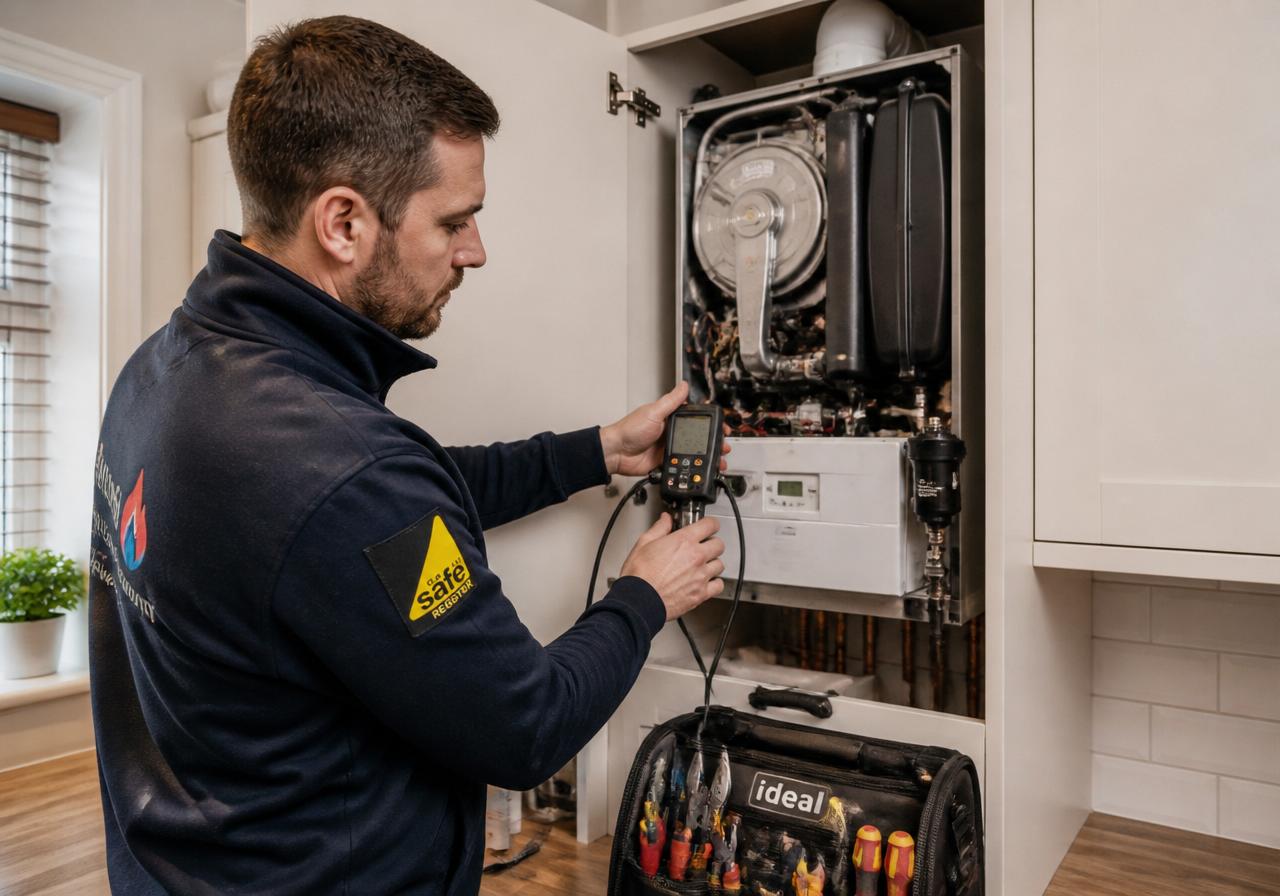
Gas Safe engineer performing flow and temperature diagnostics on a residential boiler in Westhoughton.

Typical boiler kettling or banging — the diagnostic sequence work in Westhoughton

For Westhoughton householders and landlords dealing with the diagnostic sequence. Local housing stock — 1990s–2000s developer estates alongside older terraces around Market Street — shapes how this work is carried out.

  • Boiler making kettle-like noises
  • Rumbling sounds from central heating
  • Banging noises during boiler operation
  • Boiler cutting out due to overheating
  • Reduced hot water pressure alongside noise

Initial Assessment: Flow Rate and Differential Temperature

When we arrive at a property in Westhoughton reporting boiler kettling, our first step is always to assess the boiler's flow rate and the differential temperature across the heat exchanger. We use specialised equipment to measure how much water is moving through the boiler and the temperature difference between the inlet and outlet pipes. This critical initial diagnostic tells us if the boiler is struggling to dissipate heat efficiently. A low flow rate or an unusually high temperature differential strongly suggests an issue with water circulation through the appliance itself.

  • Measure boiler inlet/outlet temperatures
  • Calculate temperature difference (delta T)
  • Assess system flow rate through boiler
  • Identify immediate circulation issues

Addressing Flow Issues: Filters, Pumps, and Balancing

If our initial checks point to restricted flow, we systematically investigate the components that govern water circulation. This involves checking the system filter – often a magnetic filter – for blockages, ensuring the circulating pump is running at its correct speed and is not undersized or faulty, and verifying the system is properly balanced. An unbalanced system or a partially closed valve can starve the boiler of adequate water flow, even if other components are functional. Correcting these flow issues often resolves the kettling by allowing heat to be carried away effectively.

  • Inspect system filter for blockages
  • Verify pump speed and operation
  • Check system balancing valves
  • Ensure adequate water flow to boiler

When Scale is the Culprit: Descale and Protection

If flow rates are acceptable and the temperature differential remains problematic, or if initial flow corrections don't fully resolve the kettling, we then focus on internal heat exchanger contamination. This is where limescale build-up comes into play. Especially in areas with harder water, limescale can form a layer on the heat exchanger surface, insulating it and causing localised overheating. For older properties around Market Street, or even 1990s–2000s developer estates in Westhoughton, limescale is a common issue. Our diagnostic confirms this before proceeding with a chemical descale and recommending a permanent scale reducer on the mains water inlet to prevent recurrence.

  • Confirm limescale presence internally
  • Recommend chemical descale procedure
  • Advise on mains scale reducer installation
  • Prevent future scale accumulation

Local facts — Westhoughton

Postcode
BL5
Council
Bolton Council
Nearest road
A6 Manchester Road
From Wigan
6 miles east

Westhoughton is a growing commuter town on the Bolton border, with Westhoughton railway station and Central Park as the local landmark.

Why locals choose Brogas here

As a Gas Safe registered business, Brogas always follows a methodical diagnostic sequence. We methodically check flow rates, differential temperatures, and system components. This ensures an accurate diagnosis, leaving you with a reliably functioning boiler and peace of mind.

Nearby areas we also cover

Westhoughton FAQs — boiler kettling or banging — the diagnostic sequence

Can I ignore boiler kettling?+

Ignoring boiler kettling is strongly advised against. It signifies serious internal issues like localised overheating, which rapidly degrades the heat exchanger. This component is the most expensive part of your boiler, and delaying a repair will almost certainly lead to a much larger, more costly repair or even a full boiler replacement sooner than necessary.

Is this issue common in Westhoughton?+

Kettling can affect boilers anywhere, but depending on water hardness and system age, it can be more prevalent. Westhoughton's housing stock, from older terraces to newer estates, means we encounter various system conditions. Limescale can be a factor, particularly in areas with harder water, which we account for in our diagnostics.

What is a power flush and when is it needed?+

A power flush is a process using a high-flow pump and chemicals to clean the heating system, removing sludge and debris (magnetite). It's typically needed when diagnostics show significant sludge build-up restricting flow, rather than just limescale. It improves circulation and efficiency, addressing a key cause of kettling.

How long does the diagnostic process take?+

The initial diagnostic sequence typically takes 30-60 minutes, depending on system complexity and ease of access. This allows us to accurately identify the root cause before recommending any specific remedial action. The goal is a precise diagnosis, not a quick guess.

In summary

Boiler kettling or banging indicates internal overheating. Our Gas Safe engineers follow a precise diagnostic sequence, checking flow and temperature, then addressing sludge, pump issues, or limescale for a lasting repair.