
Next-day callout slots available for Wigan & surrounding areas

The Frequent Suspects: Gas & Ignition

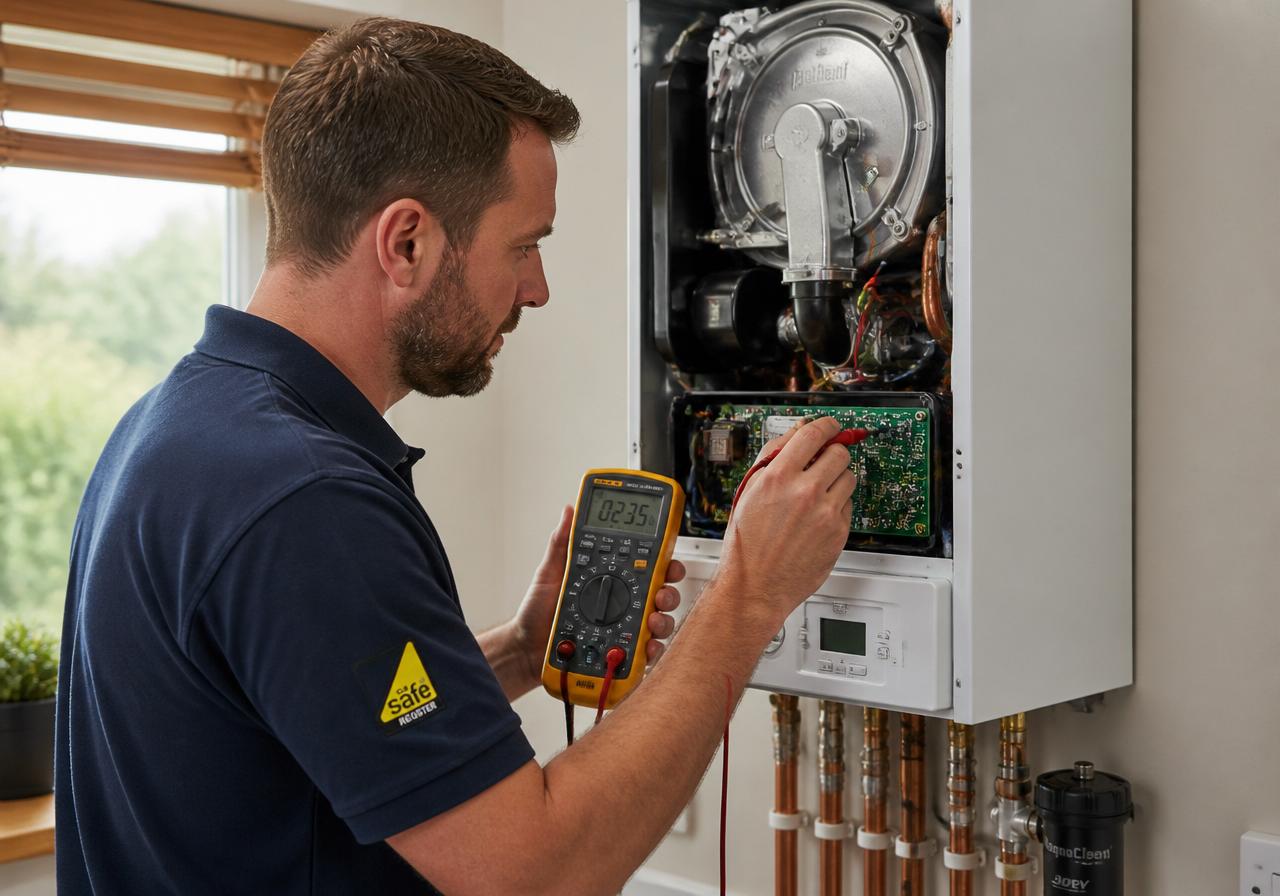
By far the most common cause we find for ignition lockouts is an issue with the gas supply or the boiler's ignition components. This could be anything from a partially closed isolation valve on the meter to a failed ignition lead or a worn flame-sensing electrode. In older properties, sometimes the main gas supply can be less robust, especially when other high-demand appliances are active. We begin by checking the gas working pressure directly at the appliance to rule out external supply issues. Then, we focus on the boiler's internal ignition system.

  • Inspect main gas isolation valve
  • Test appliance gas working pressure
  • Examine ignition/flame-sense electrode
  • Test ignition lead and spark generator

The Less Obvious Culprits: Condensate & Air/Gas Mix

While less frequent than ignition component failures, a blocked condensate trap is a surprisingly common cause of a secondary lockout. If the condensate cannot drain, it can back up and trigger a pressure switch or cause the boiler to shut down as a protective measure. Another often-overlooked issue, particularly in units that haven't been serviced regularly, is an air/gas ratio that has drifted out of specification. This prevents efficient ignition and flame establishment. These issues require careful inspection and adjustment, not just a reset.

  • Check condensate trap for blockage
  • Clear condensate pipework
  • Analyse flue gas for air/gas ratio
  • Adjust air/gas mixture if necessary

The Rare but Crucial: Upstream Gas Issues

Occasionally, the problem isn't directly with the boiler but further upstream in the gas supply. This is less common in modern installations but can sometimes be a factor in older properties, particularly if recent work has been done on the gas network or if other gas appliances in the property are malfunctioning. While we primarily focus on the appliance itself, if our initial checks indicate a stable boiler gas pressure, we might suggest contacting your gas supplier for further investigation. This helps differentiate between an appliance fault and a wider supply problem.

  • Verify external gas supply integrity
  • Check gas meter functionality
  • Identify potential upstream supply issues
  • Consult gas network operator if needed

Typical boiler ignition lockout — root causes ranked by how often we see them work in Ashton-in-Makerfield

For Ashton-in-Makerfield householders and landlords dealing with root causes ranked by how often we see them. Local housing stock — Edwardian terraces along Warrington Road and generous 1950s semis toward Bryn — shapes how this work is carried out.

  • Gas isolation valve fully open and clear
  • Electrode is clean and correctly positioned
  • Spark is strong and consistent
  • Condensate trap is clear and draining
  • Combustion analyser shows correct air/gas mix

Why locals choose Brogas here

As a Gas Safe registered business, Brogas provides thorough boiler diagnostics. We methodically check all relevant parameters, including gas pressure, ignition components, and combustion analysis. You are left with a clear understanding of the fault and a boiler that operates safely and efficiently.

Ashton-in-Makerfield FAQs — boiler ignition lockout — root causes ranked by how often we see them

Why shouldn't I just keep resetting my boiler?+

Repeatedly resetting an ignition lockout is risky. The lockout is a safety feature; it means the boiler detected an unsafe condition. Continuously forcing it to try and light without resolving the underlying fault can potentially damage components or, in rare cases, create a hazardous situation. Always call a Gas Safe registered engineer.

How do you confirm a gas supply issue at the boiler?+

We use a calibrated manometer to measure the gas working pressure at the appliance's test point. This tells us if the boiler is receiving the correct amount of gas it needs to light and operate safely. If the pressure is too low, we investigate further up the supply chain.

What does 'flame-sense electrode' do?+

The flame-sense electrode is a small rod that protrudes into the burner area. When the boiler ignites, a tiny electrical current passes through the flame via this electrode, confirming to the boiler's circuit board that a flame is present. If it's dirty, corroded, or faulty, the boiler won't 'see' the flame and will shut down.

Can a cold snap cause an ignition lockout?+

Yes, indirectly. During very cold weather, condensate pipes can freeze, especially if they run externally or through unheated spaces. A frozen condensate pipe will block the drainage, leading to a build-up and a secondary lockout as the boiler tries to protect itself. This is more common in properties further from Wigan with longer external pipe runs.

In summary

We detail the common causes of boiler ignition lockouts in Ashton-in-Makerfield, focusing on gas supply, ignition components, and condensate issues.